Minimalist Home Workout Routine: 3-Day Functional Split
Discover a science-backed home workout routine using the 3-day split method. Build functional strength with limited equipment and HIFST principles.
Meta Description: Build functional strength with this science-backed 3-day split home workout routine. Perfect for busy professionals using limited equipment and HIFST principles.
Disclaimer: Consult a healthcare professional before starting any new fitness routine.
Minimalist 3-Day Split: The Ultimate Home Workout Routine
Discover a science-backed home workout routine using the 3-day split method. Build functional strength with limited equipment and HIFST principles.
Minimalist Home Workout Routine (at a glance):
- Methodology: HIFST (High-Intensity Functional Strength Training) for functional strength.
- Goal: Build functional strength, improve daily capacity, reduce injury risk.
- Equipment: Limited: bodyweight, resistance bands, light dumbbells/kettlebells.
- Frequency: 3 sessions/week, with one rest day between each.
- Intensity: Vigorous effort, push limits, focus on time under tension & minimal rest.
- Program Length: 12 weeks for meaningful physical baseline changes.
Why This Home Workout Routine Works: The Science of HIFST
Let’s clear up a common misconception immediately: effective training does not require a commercial facility filled with heavy machinery. The modern approach for time-constrained individuals focuses on High-Intensity Functional Strength Training (HIFST). This methodology combines vigorous effort with movements that mimic real-life physical demands.
In a home setting, vigorous effort doesn't necessarily mean lifting maximal weights. It means pushing your body to its limits through bodyweight exercises, resistance bands, or light dumbbells, focusing on time under tension and minimal rest. This approach ensures your cardiovascular system is challenged while your muscles are stimulated for growth.
Movements that mimic real-life demands—squats, lunges, pushes, pulls, and carries—are the fundamental patterns we use daily. By training these patterns with intensity, you enhance your functional capacity, making everyday tasks easier and reducing injury risk. This holistic development is a cornerstone of the HIFST philosophy, ensuring that every minute of your workout contributes to practical, transferable strength.
You do not need complex equipment to trigger adaptation. Adaptation is simply the body's physiological process of getting stronger to handle stress. A home-based 12-week high-intensity functional strength training (HIFST) intervention has been shown to be highly effective. The goal isn't just to burn calories; it is to build capability that translates directly to your daily routine.
Time is often the biggest barrier we face. You might worry that a home workout routine lacks the volume required to generate results. However, studies utilizing 12-week protocols indicate that three months is sufficient time to track meaningful changes in your physical baseline. Engaging in muscle-strengthening activities for just 30–60 minutes per week is associated with a 10–20% lower risk of all-cause mortality. You are not just training for aesthetics; you are securing your long-term health with a minimal time investment.
Implementing the 3-Day Split for Your Home Workout
To put theory into practice, here is a minimalist 3-day split designed to build functional strength using just dumbbells or kettlebells. Perform this routine with one day of rest between sessions.
Day 1: Strength & Stability (Push + Squat)
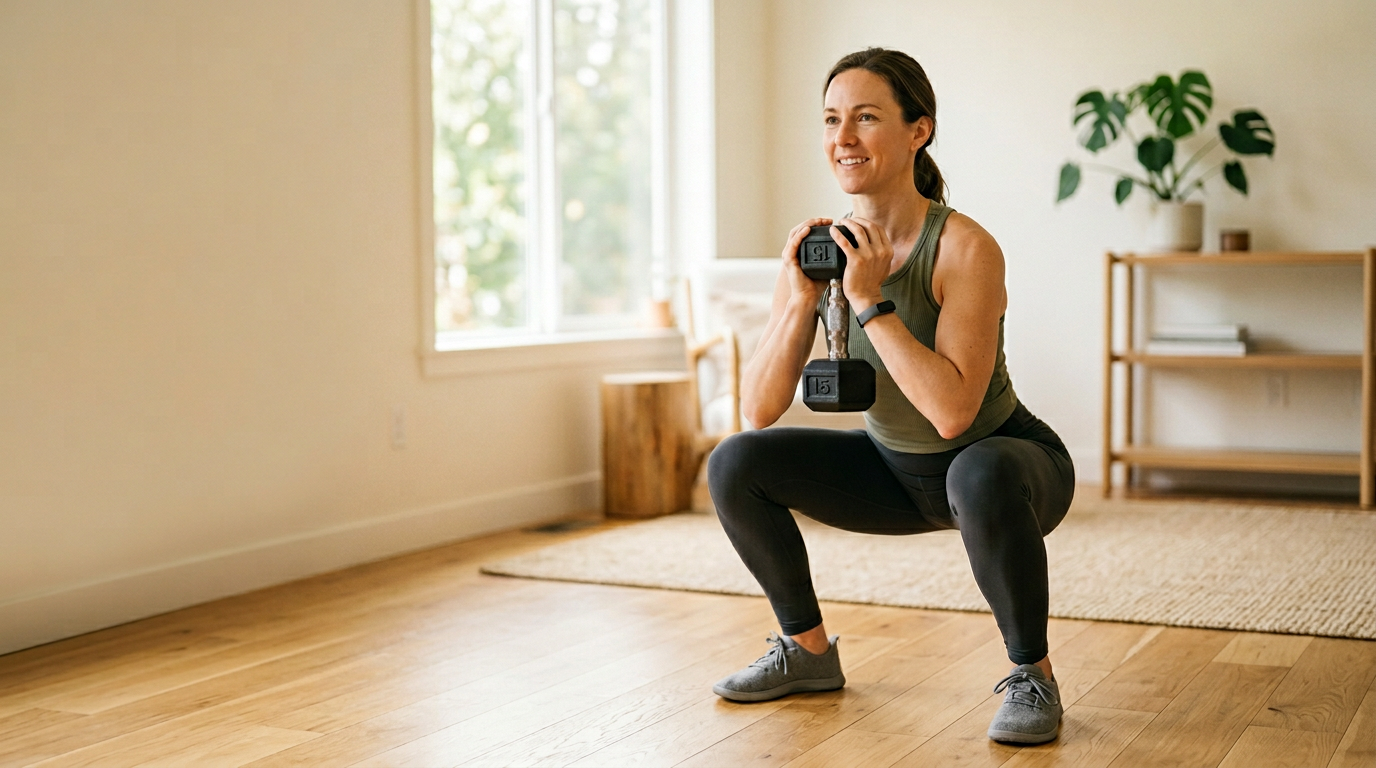
- Goblet Squats: 3 sets x 10–12 reps (Focus on depth and keeping the chest up)
- Push-ups (or Dumbbell Floor Press): 3 sets x AMRAP (As Many Reps As Possible with good form)
- Overhead Press: 3 sets x 8–10 reps (Keep core tight to avoid arching)
Day 2: Power & Posterior Chain (Pull + Hinge)
- Romanian Deadlifts (DB or KB): 3 sets x 10–12 reps (Hinge at the hips, feel the stretch in hamstrings)
- Single-Arm Rows: 3 sets x 10–12 reps per side (Control the tempo)
- Kettlebell Swings (or DB Swings): 4 sets x 15 reps (Explosive hip snap)
Day 3: Functional Capacity (Unilateral + Carries)
- Reverse Lunges: 3 sets x 10 reps per leg (Challenge your balance)
- Farmer’s Carries: 3 sets x 45 seconds (Walk with heavy weights, maintaining perfect posture)
- Plank with Shoulder Taps: 3 sets x 30 seconds (Anti-rotation core work)
Crafting Your Effective Home Workout Plan: Lessons from Research
We often look to elite athletes for training secrets, but clinical research offers compelling data on stability and injury prevention. Researchers test stability protocols to ensure safety and effectiveness for vulnerable populations. The principle holds true for everyone: if a program can stabilize a fragile system, it acts as high-grade armor for a healthy one.
This brings us to the concept of "bulletproofing" your body through your home workout plan. Stability is not just about balance; it requires strength applied quickly under load. While some studies focus on preventing falls in older adults, the mechanism is identical for an athlete preventing an ACL tear during a pickup game. You need to react to instability instantly.
You might assume that high-intensity work is too risky to perform in your living room. However, evidence suggests that home-based high-intensity functional strength training is feasible and safe even for those with mobility limitations. If individuals facing physical hurdles can successfully execute these movements, a healthy professional certainly can.
For the busy executive, this research validates a simple strategy: You do not need a complex machine circuit. You need functional movements performed at a high enough intensity to challenge your stability. This approach creates a foundation that prevents injury during your weekend run or your daily commute.
Dumbbells vs. Kettlebells in Your Home Workout Routine
Building on these concepts, we must choose the right tools. Limited space forces a choice between the two heavyweights of home fitness.
It is often observed that while dumbbells are excellent for isolation and raw strength, kettlebells are statistically more effective for improving dynamic balance and explosive power.
Dumbbells are your scalpel. They excel at isolation, targeting a single muscle group to fix specific weaknesses. If you want to build maximum raw tissue, the predictable balance of a dumbbell allows you to push harder safely. They remain the gold standard for absolute force production.
Kettlebells act more like a sledgehammer. Their center of gravity sits outside your grip. This forces you to engage proprioception—your body's ability to sense its position in space. This tool excels at creating "flow," allowing you to transition smoothly between patterns, like a swing into a squat.
Do not view this as an either-or decision. A complete minimalist gym utilizes both tools. Use dumbbells for heavy, slow grinds like overhead presses. Switch to kettlebells for dynamic movements that elevate your heart rate. This hybrid approach builds a body that is both strong and agile.
Smart Tech for Your Home Workout Plan
We established that dumbbells and kettlebells save space, but owning the right tools does not guarantee correct usage. The missing link in a solo home workout routine is immediate feedback. When you squat alone, nobody tells you if your knees are caving in. This isolation can lead to "form creep," where bad habits slowly degrade your results.
Emerging technology solves this by embedding guidance directly into your gear. The industry is moving toward wearable stretch sensors—soft electronics that measure body position by expanding with your skin. Research suggests these sensors are effective for precise human movement monitoring. Unlike cameras, they track your joints without needing perfect lighting, providing the objective data necessary to correct your posture in real-time.
This technology also acts as a critical safety mechanism. While clinical applications use this for fall detection, in a performance context, it detects "technical failure." This is the point where your muscles fatigue and your stability breaks down. The sensor knows your form is slipping before you risk injury.
This innovation bridges the gap between privacy and professional instruction. You no longer have to choose between a convenient schedule and safe execution. Smart monitoring ensures every rep counts toward your goals, setting the stage for integrated platforms like Hoppa to adjust your programming automatically.
Key Takeaways
- Effective strength training doesn't require a gym; High-Intensity Functional Strength Training (HIFST) at home with minimal equipment can build significant functional strength.
- Prioritize exercises that mimic real-life movements like squats, pushes, and pulls to enhance daily capacity and reduce injury risk.
- Achieve results by focusing on vigorous effort, time under tension, and minimal rest, rather than relying solely on heavy weights.
- Commit to a consistent 3-day split, as even a minimal time investment of 30-60 minutes per week can lead to substantial health improvements and functional gains over three months.
- Train for holistic development, aiming to build practical, transferable strength that improves everyday tasks and secures long-term health, not just for appearance.
- Implement a structured 3-day split routine to ensure comprehensive muscle stimulation and progressive overload for optimal results.
Frequently Asked Questions
What is HIFST?
HIFST stands for High-Intensity Functional Strength Training. It combines vigorous effort with movements that mimic real-life physical demands to build practical strength.
What equipment do I need for this home workout routine?
You primarily need dumbbells or kettlebells. Many exercises can also be done with just bodyweight.
How often should I do this 3-day split workout?
Perform the routine three days a week, ensuring one day of rest between each session.
Can I build functional strength effectively at home?
Yes, effective training doesn't require a commercial gym. Home-based HIFST has been shown to be highly effective for building functional strength.
How long does it take to see results from this routine?
Studies indicate that three months is sufficient time to track meaningful changes in your physical baseline.
What are the main benefits of this minimalist home workout?
It builds functional strength, enhances daily task performance, reduces injury risk, and contributes to long-term health with minimal time investment.