How to get up from the floor after a fall: practise it first
Many people who fall can't get back up, even when unhurt. Getting up is a skill nobody teaches. Here's the NHS way up and how to practise it.
Quick question. When did you last get up off the floor? Not out of bed. Off the actual floor, from lying flat.
If you had to think about it, you're in good company. Most of us have no idea how we do it. We just do, and nobody ever checks. Then one day the floor is where you end up after the dog decides to sleep exactly where your foot was going, and it turns out nobody ever showed you the way back up.
Being unhurt isn't the same as being able to get up
You'd think getting stuck on the floor only happens when something's broken. Researchers at Yale followed about 1,100 people aged 72 and over for almost two years and asked about every fall. Of the people who fell without a serious injury, almost half couldn't get up without help at least once. Not badly hurt. Just stuck.
In Cambridge, a team kept in close touch with 110 people over 90 for a year, and the main problem they found wasn't the fall itself. It was the wait afterwards. Of those who fell, almost a third spent an hour or more on the floor, and long waits like that went with serious injuries and hospital stays. The researchers' conclusion was refreshingly practical: people need training in how to get up from the floor.
Which raises the obvious question. Who gives that training?
Getting up is a skill, and nobody teaches it
Somebody taught you to tie your shoelaces and to look both ways before crossing. Nobody sat you down, or rather lay you down, and walked you through getting up off the floor. At 8 you didn't need it. At 80 it's one of the most useful things your body can do, and you're expected to make it up on the spot, on a cold kitchen floor, with your heart going.
It is a skill, too, not just a matter of strong legs. When researchers in Michigan timed people getting up from different positions, healthy people in their 70s took about twice as long as young adults, but every one of them made it up from every position. Both groups found it quickest and easiest from hands and knees. The frailer older people in the study, who lived in supported housing, did best starting on their side with a piece of furniture to push on. The route you take matters as much as the muscle you bring.
Practice works, and it doesn't take long
Here's the cheerful bit. The same Michigan team later gave people with an average age of about 80, all of whom needed some help with everyday things like walking or bathing, six practice sessions over two weeks on the in-between positions you pass through on the way up. Compared with a group doing chair stretches, they could manage slightly more of the getting-up tasks afterwards and found it less of a struggle. They didn't get any faster. They just got up more often, which is rather the point.
There's a clever way of teaching this called backward chaining. You learn the movement in reverse order: the last step first, then the one before it, so every single practice ends with you sitting safely in a chair. Nice for the confidence, and for the knees.
A small Scottish trial tried it as five weekly 20-minute sessions, tacked onto the end of a falls prevention exercise class. Before, about three quarters of the group could get up from lying on their back using a chair. Afterwards, everyone who finished the sessions could, and they were roughly twice as quick about it. A comparison group who watched the NHS Inform video on the same thing stayed where they were. Three people with two replaced knees, who couldn't kneel on one knee, learned a version that skipped that step.
What the research can't promise you
These are small studies. The Scottish one was a pilot, and its people were already regulars at an exercise class, so they weren't exactly starting from the sofa. A review of seven backward-chaining studies, about 450 people in all with an average age of 82, found it helped people get up from the floor on their own, but the quality of the studies varied a lot. So we know people can learn the skill. Nobody has yet shown that learning it means fewer long, cold waits on the floor, though that's the whole hope.
How to practise getting up from the floor
Do this on a carpet or rug, next to a solid chair or sofa that won't slide, and have a friend or relative with you while you practise, as NHS Inform suggests. It also points out that with weak legs, or painful and stiff joints, these steps may not work for you. If that's you, or you've got replaced knees or a dodgy hip, ask your GP or a physio to help you find your own way up.
This is the NHS Inform way up, in order:
- Roll onto your side.
- Push yourself up to sit on one hip.
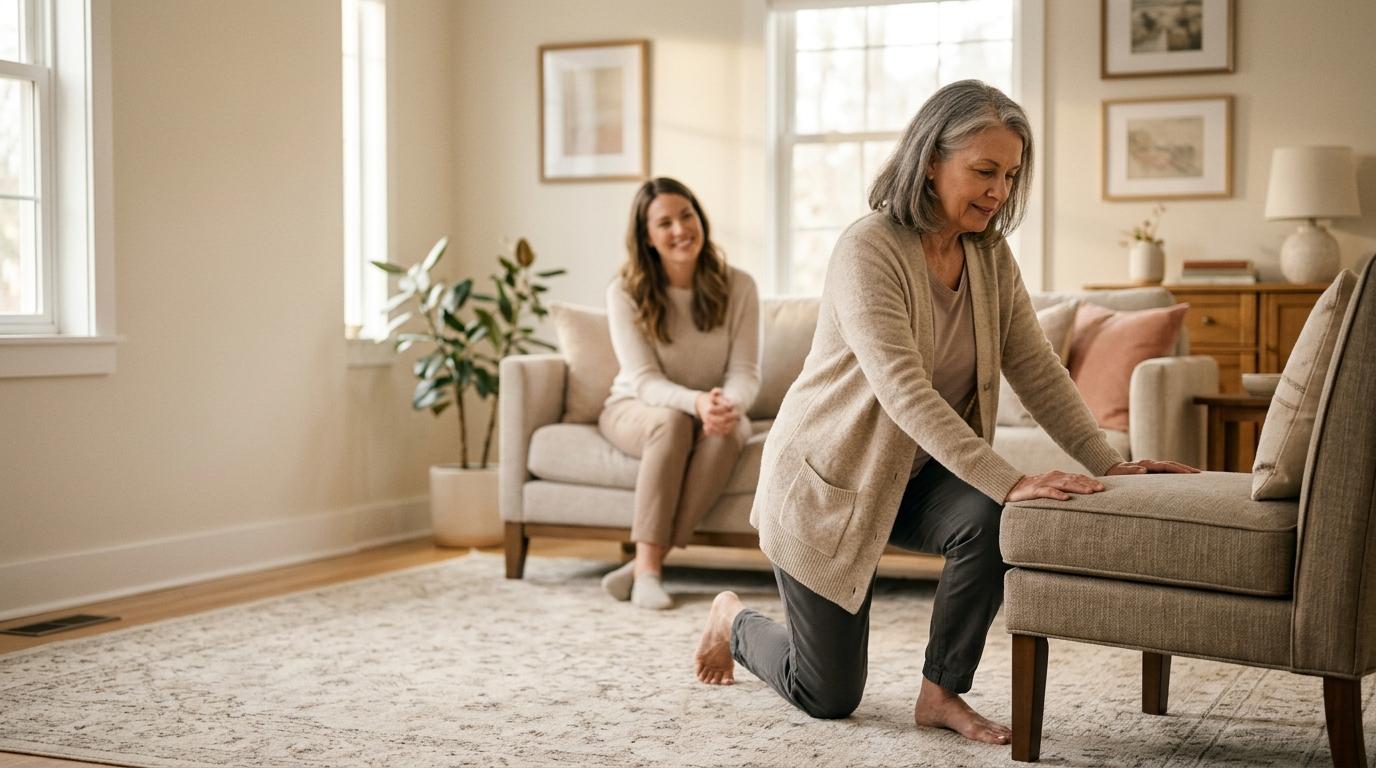
- Slowly get onto your hands and knees.
- Crawl to the chair or sofa.
- Kneel side-on to it with your stronger leg nearest, and slide that foot forward flat on the floor, other knee still down.
- Put both hands on the seat.
- Push through your hands and foot, turning as you rise, until your bottom is on the seat.
- Sit for a few minutes.
Now do it backwards, the backward-chaining way. Start kneeling beside the chair with your hands on the seat, and practise only the last push up to sitting. When that feels easy, start from hands and knees a little way off and crawl over first. Then from sitting on one hip. Lying on your side comes last, once the rest has got boring. Boring is good. Then try it in different rooms with different furniture, because you don't get to choose where you land.
And if you ever do fall, take your time and check yourself for pain or injury before you move. If you might have hurt your head, neck, back or hip, or you can't get up, call 999, or your local emergency number outside the UK. Call them first, not a relative.
While you wait, keep warm with whatever you can reach, gently move your arms and legs, and change position about every half hour. If your phone is out of reach, shout or bang on the floor. An alarm only works if you can reach it, so wear it, or keep your phone on you. The drawer is not a good place for it.
The lesson you never got
Nobody taught you to get up off the floor because nobody thought you'd need it. Hoppa is the teacher you didn't get: it shows you how to move, tells you what to fix and stays with you, so you're stronger for everything else, the floor included.
Hop up.
Sources
- Tinetti et al. (1993). Predictors and prognosis of inability to get up after falls among elderly persons. JAMA
- Fleming et al. (2008). Inability to get up after falling, subsequent time on floor, and summoning help: prospective cohort study in people over 90. BMJ
- Alexander, Ulbrich, Raheja, Channer (1997). Rising from the floor in older adults. J Am Geriatr Soc
- Hofmeyer, Alexander, Nyquist, Medell, Koreishi (2002). Floor-rise strategy training in older adults. J Am Geriatr Soc
- Seeley et al. (2026). Comparing the impact of active floor-rise training with video demonstration on fear of falling and independent floor-rise ability in older adults living in the community: a pilot cluster randomised controlled trial
- Leonhardt et al. (2020). Impact of the backward chaining method on physical and psychological outcome measures in older adults at risk of falling: a systematic review. Aging Clin Exp Res
- NHS Inform: What to do if you fall
- NHS: Falls