The $100/Hour Myth: Can AI Personal Trainers Actually Fix Your Form?
Is a form correction app safer than a human coach? We analyze 2025 research on markerless motion capture, injury prevention, and the future of home workouts.
Disclaimer: This article provides general information and is not a substitute for professional medical advice. Always consult a healthcare professional before making health or fitness decisions.# The $100/Hour Myth: Can AI Personal Trainers Actually Fix Your Form?
Is a form correction app safer than a human coach? We analyze 2025 research on markerless motion capture, injury prevention, and the future of home workouts.
The $100/Hour Myth (at a glance):
- Tech Used: Standard phone video for 3D kinematic analysis, no special sensors needed.
- Analysis: Deep learning AI provides unbiased, detailed 3D kinematic analysis of movement.
- Feedback: Receive fast, real-time form correction, often between sets, not days later.
- Accuracy: Clinical-grade precision, developed for physical therapy & neurological rehab.
- Safety: Tech developed in clinical settings (e.g., stroke rehab) for rigorous motor control.
- Future: Emerging tech combines phone video with smartwatch/earbud sensors for full-body 3D.
How "Markerless Motion Capture" Turned Your Phone into a Biomechanics Lab
Remember the days when analyzing your squat mechanics required a Hollywood budget? You used to need a spandex suit covered in reflective ping-pong balls to get accurate data. That was the gold standard. Today, that entire biomechanics lab fits in your pocket.
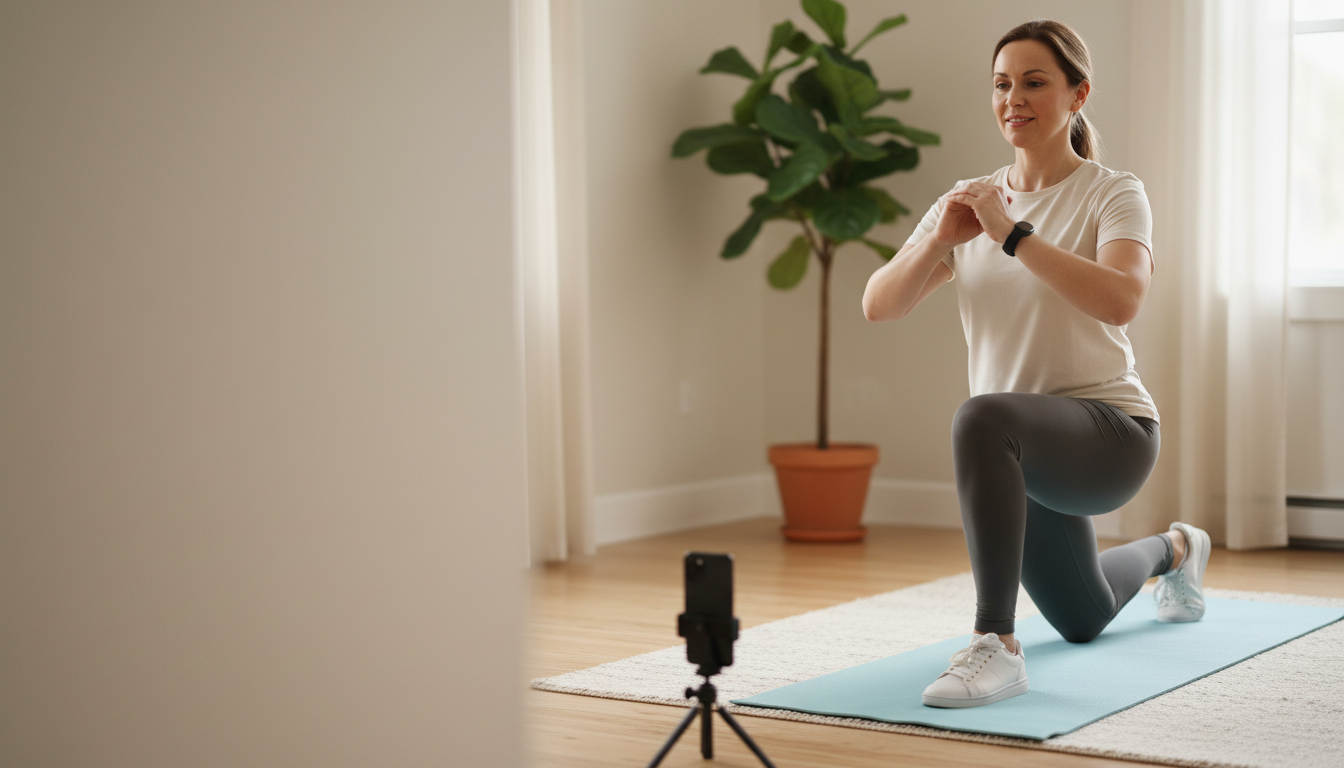
This shift is driven by markerless motion capture. This technology tracks body movement using standard video instead of attached sensors. You simply prop up your phone and record.
The real magic happens inside the software. It relies on deep learning to understand what it sees. Deep learning is an AI method that learns patterns from vast datasets. Instead of a human coach guessing if your back is straight, the AI measures it. Scientific literature highlights deep learning's specific role in enabling automated, detailed, and unbiased 3D kinematic analysis of motor behavior. It removes the subjective bias often found in human observation.6
Speed is the other major advantage for your busy schedule. You do not have time to calibrate cameras or manually process video files. Research suggests markerless motion capture has the potential to perform movement analysis with reduced data collection and processing time compared to marker-based methods. This means you get feedback between sets rather than days later.1
This isn't just a consumer gimmick. Research suggests markerless motion capture technology is now starting to be applied for clinical and rehabilitation applications. If the technology is precise enough for physical therapy, it is precise enough to refine your deadlift.2
The tech is evolving fast. Emerging systems like "MobilePoser" are now combining camera data with IMUs. IMUs are motion sensors found in smartwatches and earbuds. By syncing your phone with your watch, these tools create a full-body 3D mesh. This captures complex movements even when your body blocks the camera view.
Can an Algorithm Really Prevent Injury Better Than a Human?
You might worry that an app cannot spot bad form like a human trainer can. However, the technology powering modern fitness apps did not start in a commercial gym. It originated in clinical settings where safety is the only metric that matters.
Consider the high stakes of neurological recovery. Doctors needed rigorous tools to help patients relearn movement after life-altering events. AI applications are increasingly being explored to enhance the precision and efficiency of stroke rehabilitation. This software was designed to analyze motor control—the process by which your nervous system coordinates muscle activity.8 It does not get tired, and it does not look away.
This medical heritage is particularly relevant when we look at joint health. The anterior cruciate ligament (ACL) is a major stabilizer in your knee. Tearing it is a common fear for athletes, but these injuries rarely happen at random. Understanding understanding the biomechanical risk factors for noncontact anterior cruciate ligament (ACL) injury can aid in prevention strategies.
Biomechanics is simply the study of how forces interact with your body structure.3 A human coach is excellent at spotting obvious errors, like a knee caving inward during a squat. However, the naked eye struggles to quantify the subtle forces that accumulate over thousands of repetitions.
This is where the algorithm outperforms biological observation. Machine learning models, informed by biomechanical data, show promise in guiding ACL injury prevention strategies. Machine learning is a field of AI that finds patterns in data automatically.9 These models can identify risk factors invisible to a human observer. They detect minute deviations in your landing mechanics or deceleration patterns.
By translating these medical protocols into consumer apps, we bridge the gap between rehab and performance. You are not just getting a digital spotter. You are utilizing a safety system built on the same logic used to help patients walk again. If this technology is precise enough for clinical therapy, it is more than capable of keeping your morning workout safe.
The Precision Gap: Fatigue, Power, and "Invisible" Metrics
Most of us gauge a workout by how much we sweat or "feel the burn." But subjective sensation is a notoriously unreliable narrator. You might feel exhausted because of general systemic stress rather than local muscle failure. To bridge this gap, sports scientists rely on objective data. Reference sEMG as a standard physiological signal for monitoring muscle fatigue. Surface electromyography (sEMG) detects the electrical currents that trigger muscle contractions.4 By analyzing these signals, coaches can distinguish between true muscular power loss and simple mental fatigue.
AI coaching apps are beginning to approximate this level of insight using velocity tracking. They analyze how fast you move a weight to estimate your remaining fuel. This moves beyond simple form correction into the realm of neural optimization. Emerging work explores how combining AI with immersive VR can enhance motor control rehabilitation. Motor control is the regulation of movement by the central nervous system.10 By visualizing your body in 3D space, these tools help you understand exactly where your limbs are without looking in a mirror.
This precision is becoming essential as training goals evolve beyond simple weight loss. Research suggests an emerging trend toward Functional Bodybuilding. This approach combines the aesthetics of bodybuilding with the capability of athletic performance.7 It demands strict adherence to tempo and tension rather than just moving weight from A to B. In this protocol, precision is the primary driver of physical adaptation. If your rep speed drops significantly, you might be done for the set. A human coach sees this intuitively. Now, algorithms are learning to see it too. They turn invisible metrics into actionable decisions so you stop wasting energy on "junk volume."
The Verdict: Replacing the Coach vs. Augmenting the Athlete
Let's stop asking if an algorithm will replace your personal trainer. The most effective strategy isn't binary. It is collaborative. It is often observed that a "hybrid" model combining AI structure with human accountability is statistically superior for weight loss.11 This pairing mitigates the weaknesses of using either method alone. The machine provides the data while the human provides the drive.
For most professionals, the primary hurdles to consistent coaching are cost and frequency. Hiring a human to watch every single workout is financially unrealistic for many. A trainer cannot be there at 5:00 AM every Tuesday or during a late-night hotel session. AI solves this friction. It provides affordable and constant monitoring without the scheduling headaches. You get accountability every time you step into the gym.
The software is also becoming surprisingly adept at customization. It is no longer just a static spreadsheet. AI applications have the potential to facilitate tailored therapeutic delivery in stroke recovery and rehabilitation. While this research focuses on medical recovery, the implication for general fitness is clear.5 Algorithms can now adapt interventions—specific actions taken to improve health—to your needs in real-time. If your performance drops, the AI adjusts the plan immediately.
View AI as your tactical ground support. It handles the daily grind of tracking sets and adjusting weights. This frees up the human coach to act as a strategic consultant. They review the aggregated data to make high-level decisions about your long-term progression. They focus on your mindset rather than counting your reps. You get the precision of a machine and the empathy of a human. This is the smartest investment for your health.
Key Takeaways
- AI-powered markerless motion capture transforms your smartphone into a precise biomechanics lab, offering objective and detailed form analysis previously exclusive to specialized settings.
- Leveraging deep learning, this technology provides immediate, unbiased feedback on your exercise form, significantly accelerating your ability to identify and correct movement patterns.
- The clinical origins of AI form analysis ensure its precision, making it a highly reliable tool for refining complex exercises and enhancing overall movement quality.
- AI algorithms surpass human observation in quantifying subtle biomechanical forces, offering a superior method for identifying long-term injury risks that accumulate over many repetitions.
- By providing data-driven insights into motor control, AI personal trainers offer a powerful complement to human coaching, especially for preventing injuries beyond immediately visible form errors.
- The continuous evolution of AI, integrating sensors like IMUs, promises even more comprehensive and accurate 3D body tracking, further enhancing the potential for personalized fitness guidance.
Frequently Asked Questions
What is markerless motion capture?
It's technology that tracks body movement using standard video from your phone, eliminating the need for attached sensors. It relies on deep learning to analyze your form.
How do AI personal trainers analyze my form?
They use markerless motion capture and deep learning to analyze video from your phone. This provides detailed, unbiased 3D kinematic analysis of your movements.
Can AI apps prevent injuries better than a human coach?
AI algorithms can quantify subtle biomechanical forces over many repetitions, which the human eye often misses. This precision, stemming from clinical applications, aids in injury prevention strategies.
Is markerless motion capture accurate enough for serious training?
Yes, research shows it's precise enough for clinical and rehabilitation applications, including physical therapy. This indicates it's suitable for refining complex movements like deadlifts.
What is deep learning in the context of fitness apps?
Deep learning is an AI method that learns patterns from vast datasets to understand body movements. It allows the software to measure and analyze your form objectively.
How does this technology provide feedback quickly?
Markerless motion capture significantly reduces data collection and processing time compared to older methods. This means you can receive feedback between sets, not days later.
What are IMUs and how do they enhance AI trainers?
IMUs (Inertial Measurement Units) are motion sensors found in smartwatches. When synced with your phone, they create a full-body 3D mesh, capturing complex movements even when the camera view is blocked.
Sources
- [1] Markerless motion capture has the potential to perform movement analysis with reduced data collection and processing time compared to marker-based methods. — https://doi.org/10.7717/peerj.12995
- [2] Markerless motion capture technology is now starting to be applied for clinical and rehabilitation applications. — https://doi.org/10.7717/peerj.12995
- [3] Understanding the biomechanical risk factors for noncontact anterior cruciate ligament (ACL) injury can aid in prevention strategies. — https://doi.org/10.1177/23259671241312681
- [4] Surface electromyography (sEMG) is a widely used and valid method for assessing exercise fatigue and power output. — https://doi.org/10.3389/fnsys.2022.893275
- [5] AI applications have the potential to facilitate tailored therapeutic delivery in stroke recovery and rehabilitation. — https://doi.org/10.3390/s24206585
- [6] Deep learning techniques enable automated, detailed, and unbiased 3D kinematic analysis of motor behavior. — https://doi.org/10.1007/s11910-020-01049-z
- [7] Emerging trend: Functional Bodybuilding — https://www.instagram.com/reel/DSVKR9CEZJC/, https://www.instagram.com/p/DSUtm9yD24g/, https://blog.muscleblaze.com/generalfitness/metabolic-flexibility-the-new-weight-loss-goal/, https://m.economictimes.com/us/life/zone-2-cardio-the-secret-to-endurance-longevity-and-better-health/articleshow/126035049.cms, https://www.bubsnaturals.com/blogs/creatine-and-fitness/powering-performance-how-does-creatine-help-women, https://www.instagram.com/reel/DSVKR9CE2JC/
- [8] AI in Stroke Rehabilitation — https://doi.org/10.3390/s24206585, https://doi.org/10.26355/eurrev_202306_32598
- [9] AI in ACL Injury Prevention — https://doi.org/10.1177/23259671241312681
- [10] AI-Enhanced Virtual Reality — https://doi.org/10.1097/WCO.0000000000001321
- [11] The "Hybrid" Model is Statistically Superior for Weight Loss**
- **Category:** Scientific Finding
- While AI offers structure, human accountability drives results. — https://news.umich.edu/human-ai-coaching-models-boost-weight-loss/